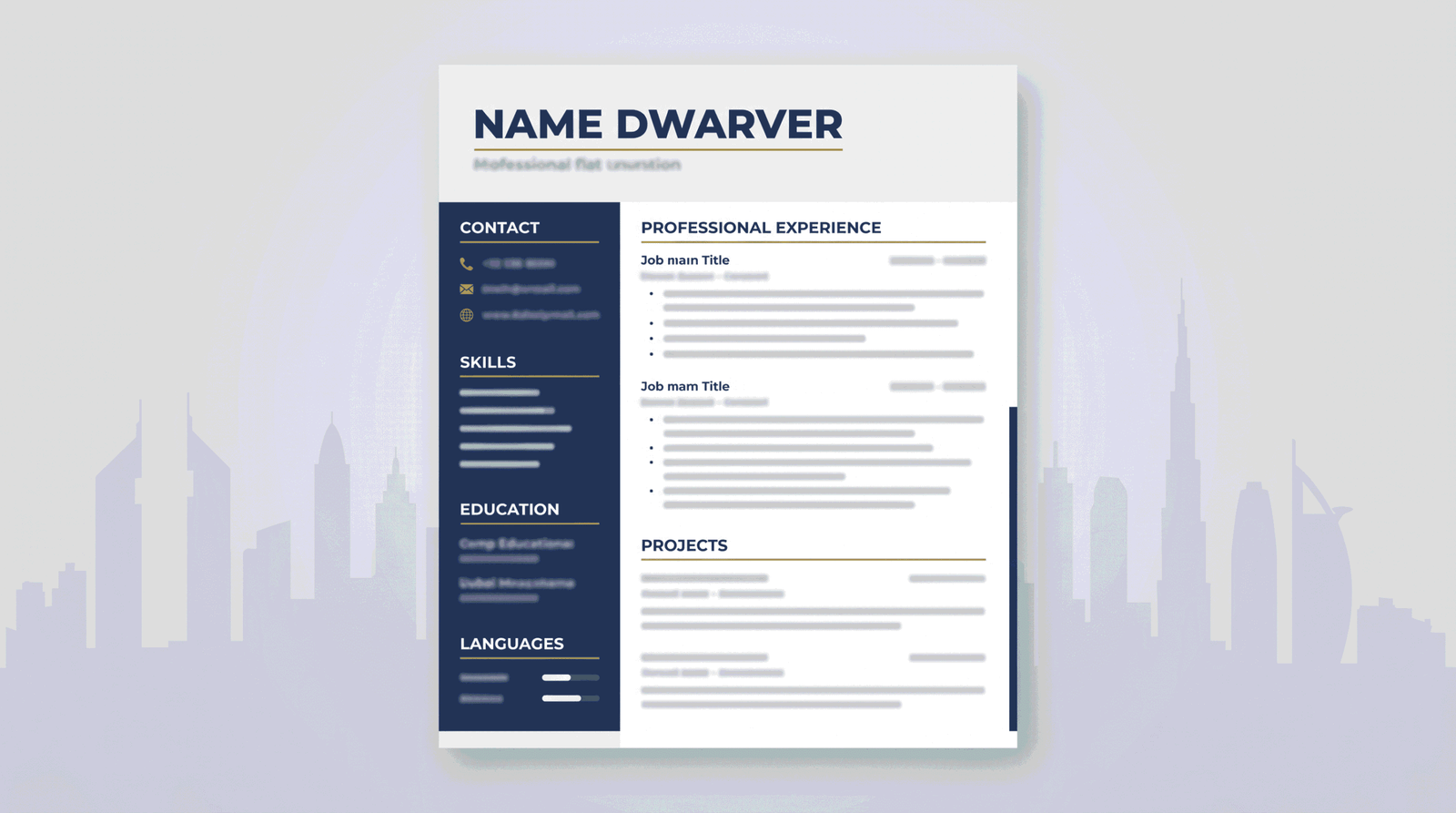
If you’re applying for jobs in Dubai and wondering whether to send a resume or a CV — you’re not alone. Many UAE job seekers, especially expats, use these terms interchangeably. But they are different documents, and sending the wrong one to the wrong employer can quietly cost you an interview.
This guide cuts through the confusion. By the end, you’ll know exactly which format Dubai employers expect for your industry, your experience level, and the platforms you’re applying through.
Resume vs CV — The Global Definition
Before we look at the UAE specifically, here’s the international baseline:
| Feature | Resume | CV (Curriculum Vitae) |
|---|---|---|
| Length | 1–2 pages | 2–6+ pages |
| Focus | Relevant experience for one role | Full academic and professional history |
| Customisation | Tailored per job application | Comprehensive and largely static |
| Used in | USA, Canada, Australia, private sector globally | UK, Europe, Middle East, academia, healthcare |
| Includes | Summary, skills, work history, education | All of the above + publications, research, licences |
How Dubai and the UAE Actually Use These Terms
Here’s where it gets specific to the Gulf: UAE employers use “CV” as the default term for almost any job application document. If a job posting on Bayt.com or NaukriGulf says “send your CV,” they almost certainly mean a professional document that looks like what most of the world calls a resume — two pages, focused, experience-led.
That said, the format behind the label matters. Certain industries — healthcare, education, senior executive roles — genuinely want the longer, detailed CV format. Others want the concise, achievement-focused resume format, even if they call it a “CV.”
Understanding this distinction is what separates candidates who get screened in from those who don’t.
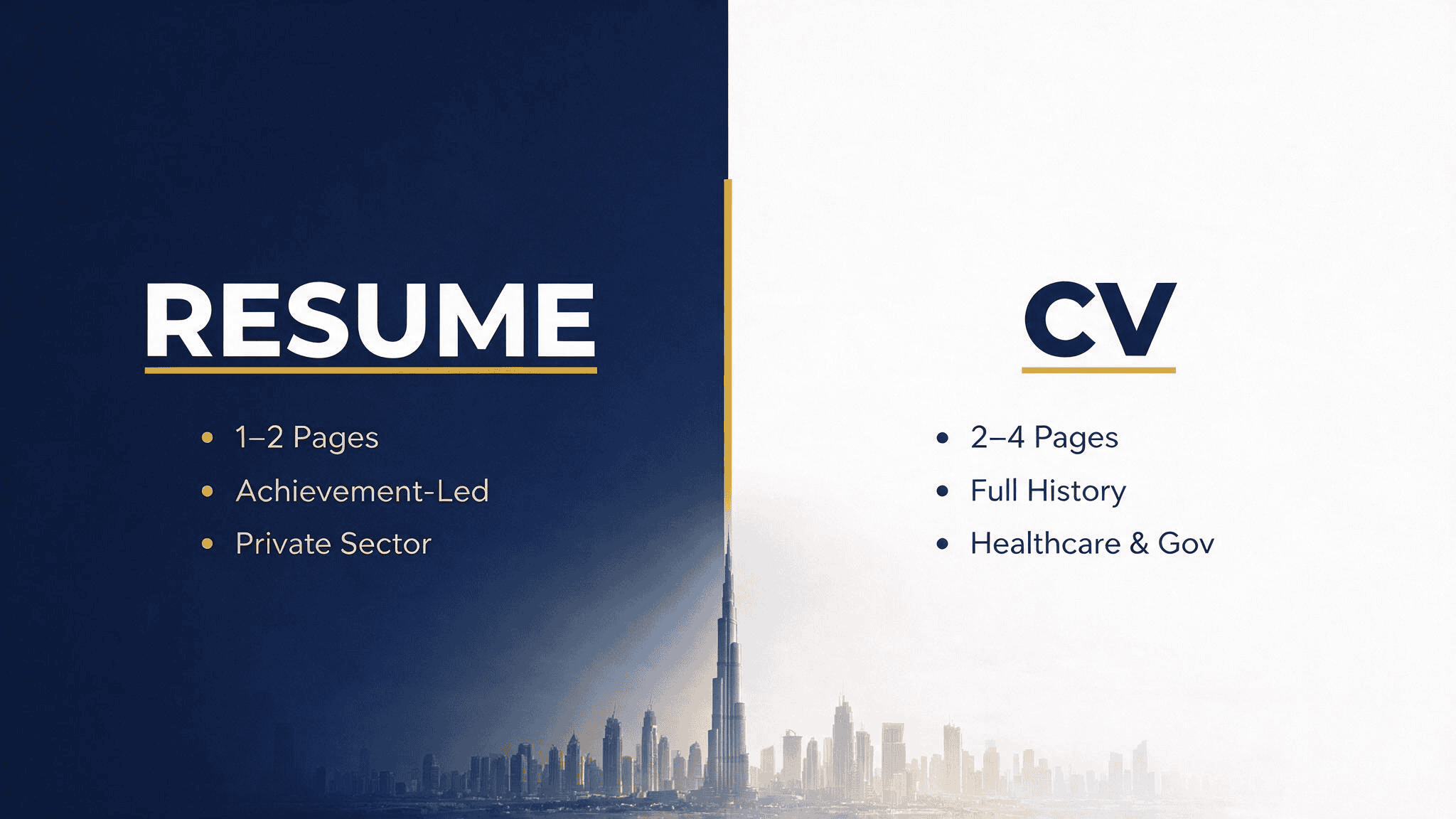
Dubai Resume vs CV — The Key Differences at a Glance
| Dubai Resume | Dubai CV | |
|---|---|---|
| Ideal length | 1–2 pages | 2–4 pages (healthcare/academic: up to 6) |
| Top section | Professional summary (3–4 lines) | Personal profile + licensing/credentials |
| Work history | Achievements-led, last 10 years | Full chronological history, all roles |
| Education | Degree + institution, concise | Full academic record, all qualifications |
| Licences | Listed briefly in a skills section | Dedicated section — DHA/HAAD/DOH, MOH, etc. |
| Photo | Optional (common in UAE) | Expected in most UAE/Gulf markets |
| Nationality | Optional | Expected (visa status matters) |
| Best for | Private sector, tech, finance, sales, marketing | Healthcare, education, government, senior executive |
When Dubai Employers Want a Resume
The resume format — concise, achievement-led, two pages maximum — is the right choice when you’re applying to:
- Private sector companies — multinational corporations, financial services firms, tech companies, and retail brands dominating Dubai’s business districts (DIFC, Business Bay, JLT) all expect a tight, results-oriented resume.
- Sales, marketing, and commercial roles — hiring managers here scan for numbers fast. Revenue targets hit, campaigns launched, markets entered. A dense CV buries those facts.
- Tech and digital roles — software engineers, data analysts, product managers, and UX designers applying to UAE tech companies should lead with skills and portfolio impact on a clean, ATS-friendly resume.
- SMEs and startups — smaller UAE employers hiring quickly want relevance, not volume. A focused one-page or two-page resume shows you respect their time.
- LinkedIn UAE and Indeed UAE applications — these platforms are optimised around the resume format. A condensed, keyword-rich document performs better through their ATS filters.
If you’re writing a Dubai-format resume from scratch, start with our full guide: Dubai Resume Format 2026 — The Complete Guide.
When Dubai Employers Want a CV
Some sectors in the UAE have a genuine need for the longer, comprehensive CV format. In these cases, a two-page resume will actually work against you — it looks like you’re hiding your credentials:
- Healthcare — DHA, HAAD, DOH, and MOH licensing requirements mean your CV must include full qualification history, all registration numbers, and detailed clinical experience. Hospitals and clinics rely on this detail to process licences before interviews even happen.
- Education and academia — schools, universities, and training institutes in the UAE expect a full CV covering your degrees, teaching licences, publications, research, and all institutions you’ve taught at.
- Government and semi-government roles — entities like ADNOC, RTA, DEWA, and ministries typically require detailed CV submissions, sometimes through structured government portals with mandatory fields.
- Senior executive and board-level roles — at C-suite level, a comprehensive CV signals seniority. Two-page documents at this level are read as junior-candidate submissions.
- Engineering consultancies and contractors — large project-based firms in oil & gas, infrastructure, and construction want your full project history, certifications (RICS, PMP, NEBOSH), and licences in a dedicated section.
If a CV is what you need, see our complete Dubai CV Format 2026 guide — covering structure, sections, and what Gulf employers specifically look for.
Industry-by-Industry: Resume or CV for UAE Jobs?
| Industry | Format to Use | Key Reason |
|---|---|---|
| Banking & Finance | Resume | Achievement-led, ATS-filtered hiring on Bayt/LinkedIn |
| Technology / IT | Resume | Skills-first scanning, portfolio links preferred |
| Marketing & Sales | Resume | Numbers and results drive hiring decisions |
| Hospitality & F&B | Resume | Concise property/brand history, service metrics |
| Healthcare (clinical) | CV | DHA/HAAD/MOH licensing requires full credential history |
| Healthcare (admin) | Resume | Administrative hospital roles follow corporate norms |
| Education | CV | Full academic and teaching record required |
| Engineering (site/project) | CV | Full project history + certifications needed |
| Engineering (tech/software) | Resume | Skills and delivery record, ATS-filtered |
| Legal | CV | Full Bar admission history and practice areas required |
| Government / Semi-Gov | CV | Structured submissions with full career history |
| Retail & Customer Service | Resume | Concise, high turnover hiring — quick scanning |
| HR & Admin | Resume | Corporate private sector norm |
| Construction / Real Estate | CV | Project values, certifications, full site history |
| Media & Creative | Resume + Portfolio link | Work speaks — keep document concise |
What UAE Job Boards Expect
Bayt.com
Bayt calls everything a “CV” but their upload system and recruiter screens are optimised for two-page documents. Their ATS scans for keywords, so a skills-rich, structured resume performs well for private sector roles. Healthcare and engineering employers posting on Bayt will still expect the full CV version.
NaukriGulf
NaukriGulf is popular with Indian expat professionals and attracts blue-collar to mid-level white-collar roles. Recruiters on this platform scan fast — a concise, keyword-packed resume with clear headings works best for most roles here.
LinkedIn UAE
LinkedIn is the primary channel for professional, management, and director-level roles in Dubai. When you apply via Easy Apply, your LinkedIn profile IS your resume — but most employers also request an attached file. A polished, ATS-friendly resume PDF is expected: two pages, no graphics-heavy sidebars.
Indeed UAE
Indeed UAE skews toward SMEs and international companies with UAE offices. A clean resume with strong action-verb bullet points and quantified results performs well here.
Resume vs CV for Dubai: Quick Decision Guide
Not sure which one to use? Answer these three questions:
- What industry are you applying to? Healthcare, education, government, senior engineering, or legal → CV. Everything else → Resume.
- What does the job post specifically say? “Send your CV” in a private sector posting = they want a resume-format document. “Detailed CV required” or a structured government portal = full CV.
- What’s your experience level? Graduate to mid-level → Resume. C-suite or academic → CV.
When in doubt, use the resume format. It’s the default expectation across the vast majority of Dubai’s private sector — and a well-written two-page resume will never disqualify you the way a bloated five-page document might.
Does Your Format Need to Be ATS-Friendly?
Yes — regardless of whether you’re submitting a resume or a CV, both formats need to pass Applicant Tracking System filters to reach a human recruiter. In Dubai’s most active hiring channels, ATS screening happens before your document is ever seen by a person.
The essentials for both formats:
- Standard fonts only (Calibri, Arial, Georgia — no decorative fonts)
- No text boxes, tables used for layout, or graphics that break parsing
- Clear section headings (Work Experience, Education, Skills — not custom labels like “My Journey”)
- Saved and submitted as a PDF (unless the posting specifically requests Word)
- Keywords from the job description used in context, not in a hidden keyword dump
Our ready-made templates are built with all of this in mind — browse Dubai resume templates for 2026 to find a design that works for your industry.
One More Thing: Don’t Forget the Cover Letter
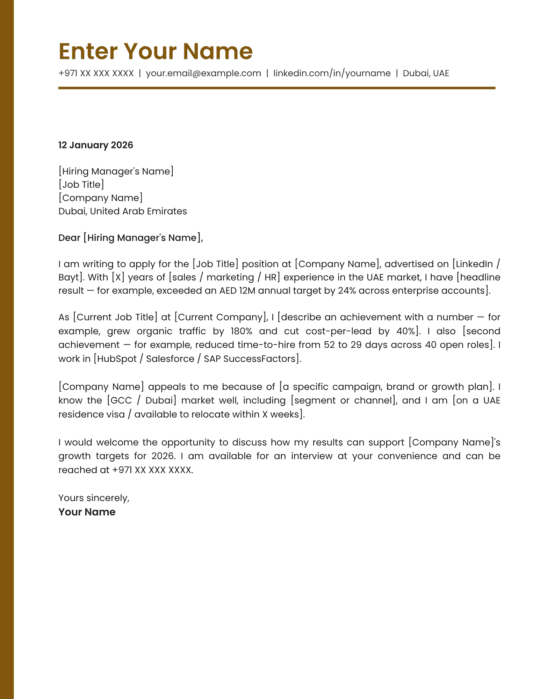
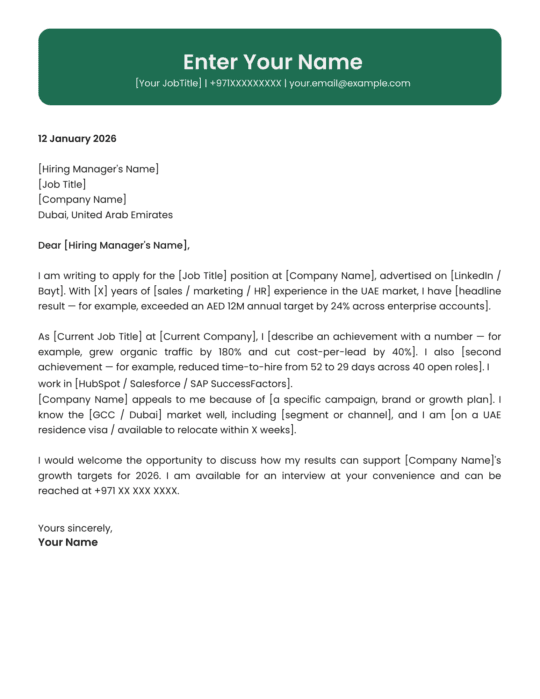
Whether you send a resume or a CV, a strong cover letter dramatically improves your response rate with UAE employers — especially for corporate and government roles where applications are competitive. See our complete guide: Cover Letter Format for Dubai Jobs 2026.
Frequently Asked Questions
Is a resume or CV better for Dubai jobs?
For most private sector roles in Dubai, a resume (1–2 pages, achievement-led) is better. Healthcare, education, government, and senior executive roles require a full CV. When in doubt, use the resume format — it’s the default across the majority of UAE private sector hiring.
Do UAE employers say “CV” when they mean resume?
Yes — very commonly. “Send your CV” in a UAE private sector job posting almost always means a professional 1–2 page document that follows resume formatting conventions. Only government, healthcare, education, and senior executive roles typically mean the longer, comprehensive CV format.
Should I include a photo on my Dubai resume or CV?
Photos are common and accepted in the UAE — unlike in the US or UK where they’re discouraged. Including a professional headshot is standard practice, particularly on CVs. On resumes, it’s optional but not unusual. Make sure the photo is formal: business attire, neutral background, good lighting.
Should I include my nationality and visa status?
Yes. UAE employers regularly use nationality and visa status to assess employment eligibility and visa processing costs. Include your nationality and current visa status (visit visa, employment visa, residence visa, etc.) near the top of your document — typically in the contact/header section.
How long should a Dubai CV be?
For most professionals: 2–3 pages. Healthcare practitioners applying to DHA/HAAD roles often submit 4–6 pages due to licensing, clinical placement, and CPD requirements. Academic CVs can run longer. A resume should never exceed 2 pages regardless of experience level.
Can I use a Canva template for my Dubai resume or CV?
Yes — as long as you choose a template built for ATS compatibility. Many Canva templates use decorative text boxes and multi-column graphic layouts that ATS systems cannot parse. Our ATS-friendly Dubai resume templates are specifically designed to look professional while maintaining clean, parseable structure for UAE job platforms.
Ready to Build Your Dubai Resume or CV?
Now that you know exactly which format fits your situation, the next step is building a document that stands out. Choose the guide that matches what you need:
- Dubai Resume Format 2026 — Full section-by-section guide for writing a UAE private sector resume
- Dubai CV Format 2026 — Complete guide for healthcare, education, government, and senior roles
- Cover Letter Format for Dubai Jobs — How to write a cover letter UAE employers actually respond to
- Browse Dubai Resume Templates — Ready-made, ATS-friendly Canva templates for all UAE industries